590
Lecture 2: Anatomy of a Journal Article / Where’s the Gap? Mapping a
Field
Topics:
What is a Journal Article? What is a Literature Review? (hours
1)
Mapping a Field (and Minding the Gap) (hour 2)
Design, Method and Structure of the Literature Review (hour 3)
Recap on Week 1
What is this course about? Do we need another course on academic
literature?
Foundational: How to Develop a Literature Review
Future-Oriented: How AI is Impacting Academic Literature /
Scholarship
Mix of Theory and Practice
How do you build a sense of your field and its gaps? This course aims
to make sense of a term – academic literature – at once mundane and
mystical. It starts with fundamentals: how to build, annotate, analyze,
map and translate a literature database into a literature review. It
progresses to think about how AI and other technology can help foster
more critical, analytic and reflexive modes of interpretation and
understandings of the field.
All required material (video lectures, readings etc.) will be
provided to students.
Recap on Week 1
Week
Theory
Practice
Assessment
1
Course Overview / Anatomy of a Journal Article / What Makes a Good
Research Question?
AI Tools for Literature
First Draft of Research Topic / Research Question
2
Academic Audiences and Techniques of Persuasion
Where’s the Gap? Mapping a Field
Design, Method and Structure of the Literature Review
3
Does Artificial Intelligence Mean Artificial Knowledge? How AI is
Impacting Academia
Vibe Scholarship (Is It as Bad as It Sounds?)
Concept Map of the Literature
4
Finding Your Scholarly Voice: Peers / Audience / Venue / Field
Drafting a section of your review in a scientific and
humanities mode
Literature Review Sample: In the Scientific Mode
5
“What Do I Know?” Towards A Sociology of Knowledge
Framing Language: “Carry” Your Reader
Frame up your Literature Review
6
The Reflexive Researcher and Interpreting Scholarship
Reflecting on your positionality vis-a-vis interpretation; drafting
a statement about AI’s epistemic role
Statement on the Use of AI in Your Literature Review / Reflection on
the Role of AI in Academia
7
The Automatic Academy? The Future of Scholarship
Compiling a complete literature review
Final Literature Review
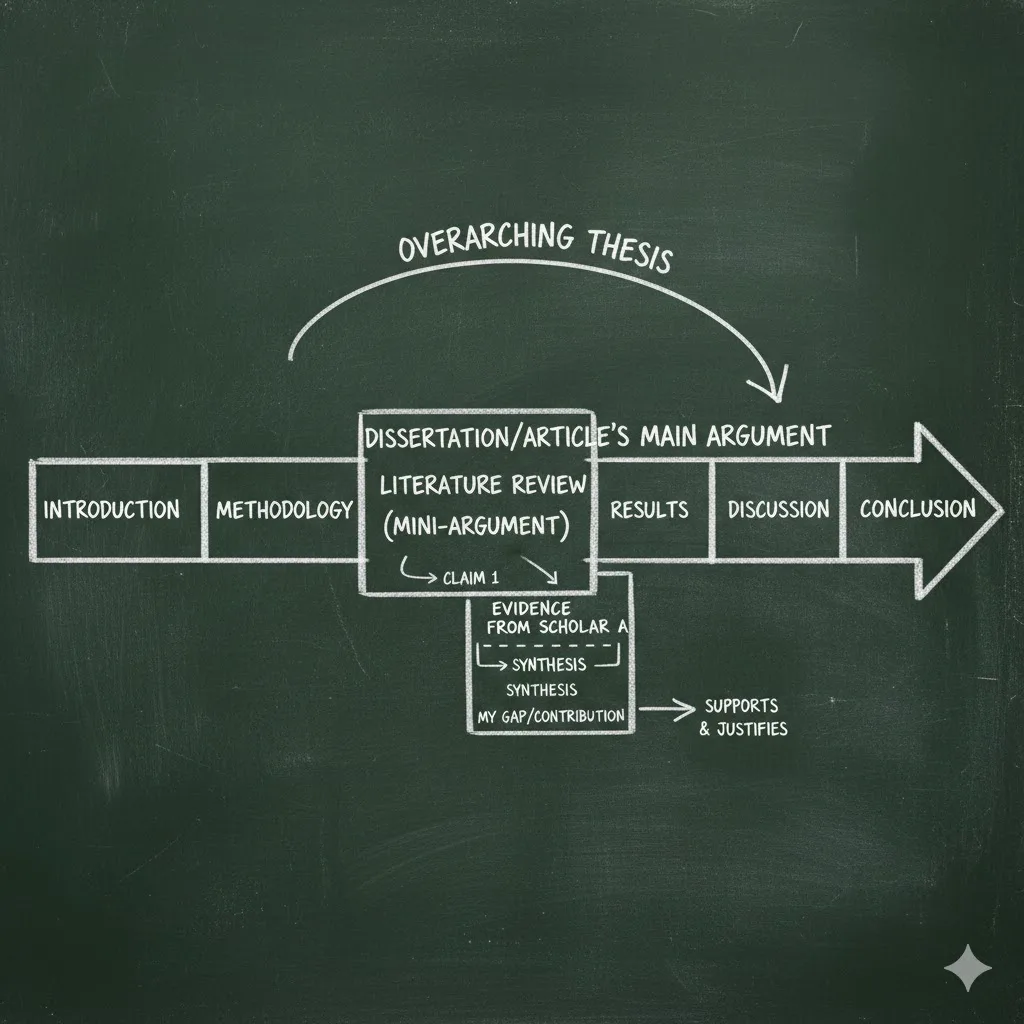
Anatomy of a Journal Article
Think back to Weber: the “Journal Article” is the vehicle of choice
for transmitting science (German: Wissenschaft, or what we
would call knowledge)
We read dozens, hundreds, thousands…
Our life is conditioned by the results of journal articles
For example, “AI” is today completely dominated by a single paper,
“Attention is All You Need” (GS cites: > 200K)
But what is a journal article? How do you analyze
one? How do you write one?
Quick history:
The “journal” is a recent invention
Convenient communication of science (17-19th centuries)
Involves the following “ontology”:
A collection of articles
bold textAuthors of the article
An editor (who reviews and assembles articles)
Peer reviewers (other scholars who the editor
invites to review articles)
A publisher (who recruits the editor,
typesets, sells and distributes the journal
to readers)
A readership (who subscribes to the journal - very
often university libraries)
Aside: Perversity of
Publishing
University libraries pay subscriptions to the
publisher for articles that its own employees have
authored (and edited and reviewed)
Why?
Are there alternatives?
Open access publishing (but questions of sustainability of volunteer
labour / reputation / distribution reach)
Laundry list of gaps -> Narrow down on the one / two that you are
likely to follow
More on tone…
Tone: Navigating The Two Cultures (see Snow 1959)
Scientist / Quantitative / Positivist
Lots of 3rd person / passive voice (“It was observed that…”) - But
note, this is changing
Humanist / Qualitative / Post-positivist or Interpretivist or
Constuctivist
More 1st person / active voice (“We noticed that”)
In the field of education, both “cultures” co-exist (sometimes even
peacefully)
How do you decide on your tone?
Two (or Three)
(Pseudo-)Random Articles
Keerthiraj, & Misra, A. (2025). Who owns the future? AI, digital
sovereignty, and the politics of knowledge. AI & SOCIETY, 1-13.
https://link.springer.com/article/10.1007/s00146-025-02641-y
Liu, J., Zhang, Y., Li, W., Wang, Q., Niu, P., & Zhang, X.
(2025). Adaptive vs. Planned Metacognitive Scaffolding for Computational
Thinking: Evidence from Generative AI-Supported Programming in
Elementary Education. Computers & Education, 105473.
https://www.sciencedirect.com/science/article/pii/S0360131525002416?casa_token=cBNpQ0r7f4oAAAAA:THnluE0eVY1uTJ3bnp1V6j-fsLEXobOB6QqoszFx_hsNacpAVPMmIe61gO70IXtFPiT2vIRcGPk
Spivak, G. C. (2023). Can the subaltern speak?. In Imperialism
(pp. 171-219). Routledge.
http://users.uoa.gr/~cdokou/TheoryCriticismTexts/Spivak-Subaltern.pdf
Why these two (three) examples? Contrasting methods, yes - but more
than this, these articles reflect different orientations towards
scholarly techniques of persuasion
First: What do we
do when we open an article?
What are the different ways of reading?
2 Common Strategies:
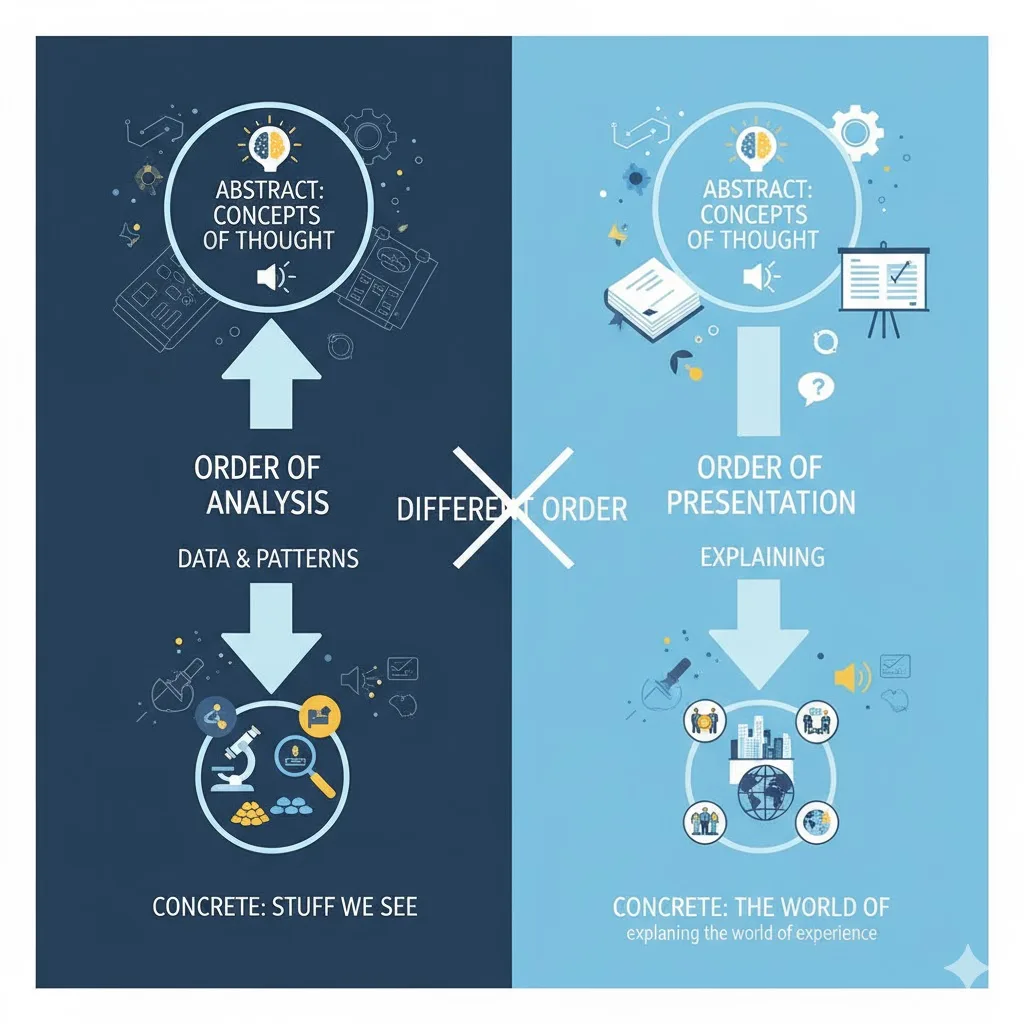
Top to bottom
Abstract, Introduction, Conclusion - then the rest
Sometimes:
Literature Review first
Methodology first (what did the researchers do?)
References first (what “space” of academia does this belong
in?)
Who
owns the future? AI, digital sovereignty, and the politics of knowledge
Keerthiraj, & Misra, A. (2025)
Keerthiraj, & Misra, A. (2025). Who owns the future? AI, digital
sovereignty, and the politics of knowledge. AI & SOCIETY, 1-13.
https://link.springer.com/article/10.1007/s00146-025-02641-y
Adaptive
vs. Planned Metacognitive Scaffolding for Computational Thinking
Liu, J., Zhang, Y., Li, W., Wang, Q., Niu, P., & Zhang, X.
(2025). Adaptive vs. Planned Metacognitive Scaffolding for Computational
Thinking: Evidence from Generative AI-Supported Programming in
Elementary Education. Computers & Education, 105473.
https://www.sciencedirect.com/science/article/pii/S0360131525002416?casa_token=cBNpQ0r7f4oAAAAA:THnluE0eVY1uTJ3bnp1V6j-fsLEXobOB6QqoszFx_hsNacpAVPMmIe61gO70IXtFPiT2vIRcGPk
Can the subaltern speak?
Spivak, G. C. (2023). Can the subaltern speak?. In Imperialism
(pp. 171-219). Routledge.
http://users.uoa.gr/~cdokou/TheoryCriticismTexts/Spivak-Subaltern.pdf
Hour 3
Designing a Literature
Review
Checklist:
What are the key terms of the (draft) research question? List
them…
What are the norms of your field? And what is your
field?
What is a reasonable method or recipe for your
literature review?
What are related terms (can AI find reasonable
synonyms)?
What do you get when you search Google Scholar /
library databases for these terms?
Do you have existing articles / authors to draw from?
What citation system are you using? Can you code / organize
literature in the way you’d like?
What is the best organization of the literature? Thematic,
field (for multi-/interdisciplinary work), chronological, spatial,
general / special?
Are there classics you are expected to cite? References
with very large number of citations (e.g. Braun & Clarke 2006;
Vaswani et al. 2017; Bender et al. 2021)?
Do some sketches: “fast”
review
Time, followed by theme, followed
by space
Just be approximate
“Criticism of AI dates back to the inception of the
field itself. For example, Dreyfus (1966 - or thereabouts) discussed the
brittleness of (etc)… By the early 1980s, scepticism voiced by
philosophers such as Searle (1981) in his famous”Chinese room”
experiment, contributed to the emergence of an AI winter. More
recently, as generative AI has largely revived the field,
criticism has been directed toward both issues of social justice
and bias (e.g. Bender et al. 2021) and potential
existential risk (e.g. lesswrong blog). In some cases,
critical AI scholars have also argued the existential case is a
convenient disguise that obscures more immediate negative social effects
(Gebru and Torres 2024). Moreover scholars from outside the
US - particularly in the Global South – have begun to argue AI
constitutes a form of neocolonialism, impacting digital
sovereignty (Keerthiraj, & Misra 2025)”
Can work with or without AI - useful just to test how this or that
understanding helps make your case (about gaps)
Don’t commit to this structure just yet!
Then develop a plan…
Tentative gap - what do you think it is?
Scaffold your review - how many sections? do you need subsections?
Add preliminary citations
Develop a sense of key transitions - what’s the drama in the review?
“also argued”, “moreover” etc
Be light, noncommital - prepared to cut/paste
As your literature grows, you might need to qualify the
statement of the gap. Maybe there are studies of the
general topic X - but you can add adjectives to the gap
(research question) to narrow it down… Go back to Step 1, rinse and
repeat…
Also consider
Different perspectives - outside the ordinary frame of discipline,
time
e.g. “heteroscopia” (“many visions”) - concept by Jaireth (2001) to
describe Indian cinema
But also a useful term for thinking about machinic vision,
generative AI
Less-known authors (especially not widely cited) - this can enrich a
review, demonstrating greater awareness beyond the same few authors /
studies…
e.g. History of AI - typically focussed on US developments. But
Schmidhuber (1922) argues the importance of developments in Ukraine
(USSR), Japan, Finland in the 1960s/70s. Who knew?
In short: surprise us!
Growing your database
Different techniques for expanding your database:
Search (Google Scholar / library databases)
With existing articles:
Go back: Scan references of this
article
Go forward: Search for citations of this
article
Go sideways: What else was published in the same
journal / issue
Check common “authorities”: Wikipedia, syllabi, AI
e.g. “Critical AI” - people will be citing Bender et al. (2021)
stochastic parrots paper
This Week’s Activity
Write down the gap (should be close to your research question)
Write down your assumed audience / field. What do you know about
them? Do they prefer lots of recent citations (science)? Or fewer, with
more emphasis on the classics (philosophy, theory, some qual
studies)?
Create a short plan / recipe method:
“Search for these terms / filters”
“Create a database of 10 articles”
“Scan the articles for relevance - discard those that are not
relevant”
“With remaining articles: review references, search for more recent
citations”
“Once I have 50 articles: code / annototate for relevance”
“Map out review structure; add citations, continue to search under
subheadings”
“Supply list of refs to AI and ask if I’m missing anything crucial”
<!–
Develop a rough structure of headings / subheadings
Lay in some initial citations (if you know them), with indicative
transitional language (“also”, “however” etc) –>